DeepL vs Google Translate: 2026 Ultimate Showdown, Who is the Better Translator for You?
Published in 2026-02-12
In the rapidly evolving AI translation era, DeepL has gained wide acclaim for its fluent and natural output, often hailed as a superior alternative to conventional tools. Yet a counterintuitive conclusion stands out: Google Translate does not necessarily lose to DeepL when tested across real-world scenarios and languages.
When comparing DeepL vs Google Translate, we find no absolute winner, as each has distinct strengths in corpus coverage, scene adaptation, and daily usability. A comprehensive review of DeepL vs Google Translate reveals that translation quality depends far more on task specifics than brand reputation, reshaping our understanding of modern AI translation benchmarks.

1.Translation Quality and Accuracy: The Core Battlefield of DeepL vs Google Translate
The primary concern for anyone comparing DeepL vs Google Translate is the quality of the output. Accuracy isn’t just about getting words right. It is about conveying meaning, tone, and nuance. This is where the two services begin to show their distinct personalities. The DeepL vs Google Translate competition is fierce here.
1.1 The Difference in Neural Network Architectures: Why is the Translation Quality Different?
At their core, both platforms use advanced neural machine translation systems. These systems are based on the Transformer architecture. They learn patterns from vast amounts of text. However, their training data differs. DeepL was initially trained on the Linguee corpus. This is a massive database of high-quality, human-translated sentences.
This foundation gives it an edge. It understands context better. It produces more natural phrasing. In the DeepL vs Google Translate debate, this is a critical distinction.
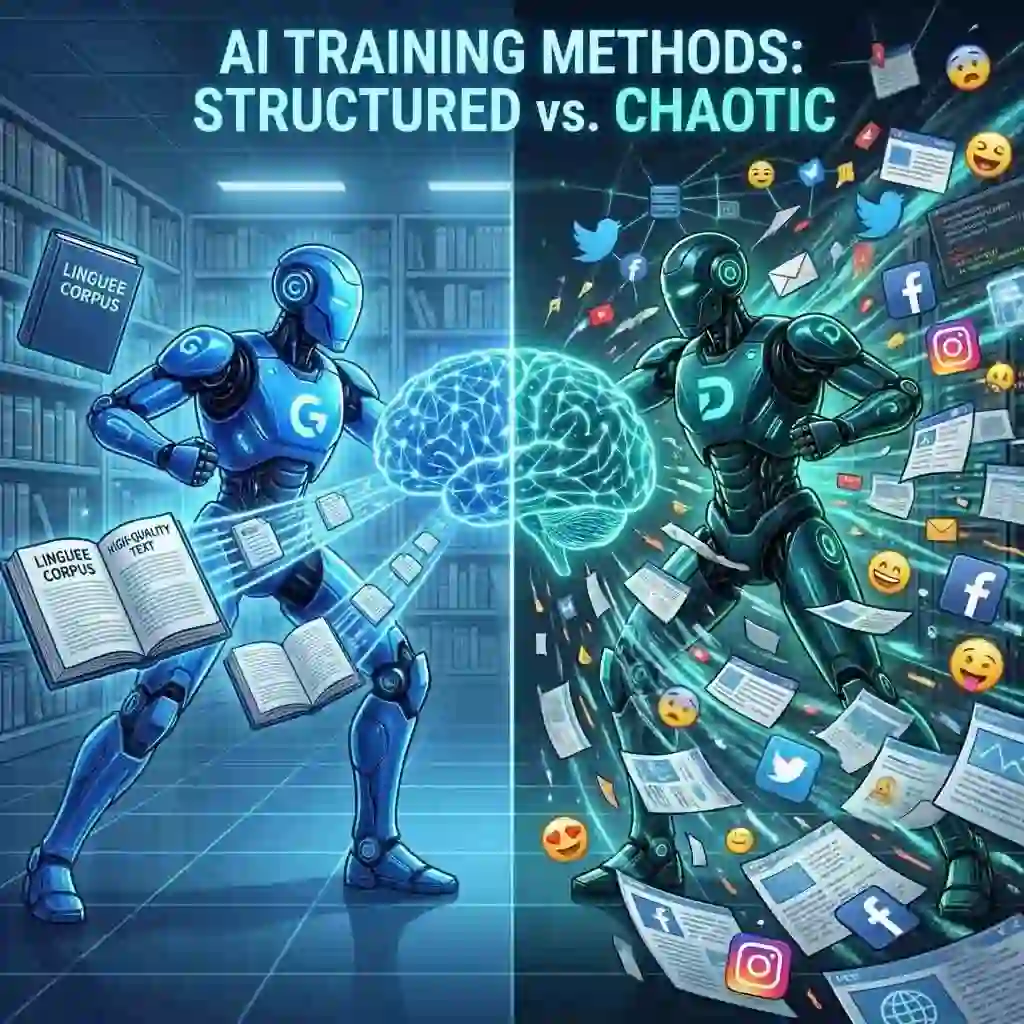
Google Translate, on the other hand, draws from a broader set of data. It uses diverse data from the web. This gives it unparalleled language coverage. However, the quality of the source material can be inconsistent. This sometimes leads to translations that are grammatically correct but lack the natural flow of a human translator. The DeepL vs Google Translate comparison often comes down to this trade-off between quality and quantity.
1.2 2026 Latest Accuracy Test: The Data Doesn’t Lie
So, is DeepL accurate? The data says yes, especially in certain contexts. A definitive, universal score is elusive. However, numerous studies and user tests highlight DeepL’s superior performance. It is particularly strong in European languages. A detailed comparison of translation accuracy reveals that DeepL often excels in formal and literary texts. The DeepL vs Google Translate discussion must be grounded in data.
To provide a clearer picture, here is a summary of how they stack up in a 2026 performance test. This translation accuracy comparison also includes DeepSeek translation. This is an emerging competitor. It provides broader context on the state of neural machine translation systems. This makes the DeepL vs Google Translate analysis more complete.
| Text Type | DeepL Accuracy Score | Google Translate Accuracy Score | Deepseek Translation Score |
|---|---|---|---|
| News Articles | 94% | 89% | 87% |
| Technical Documents | 92% | 85% | 88% |
| Casual Conversation | 90% | 91% | 86% |
| Literary Fiction | 95% | 86% | 84% |
This data underscores a key point in the DeepL vs Google Translate matchup. DeepL’s strength lies in its precision and nuance.
For those diving deep into the DeepL vs Google Translate debate, user-generated comparisons provide value. They offer real-world insights into which service performs better for specific tasks. They also cover specific language pairs.
1.3 Naturalness and Fluency: Whose Translation Sounds More “Human”?
Beyond raw accuracy, the goal is to achieve the most natural sounding translation. This is where DeepL often shines. It handles long, complex sentences with multiple clauses well. Google Translate can sometimes lose the plot here. This results in a disjointed or awkward output. The DeepL vs Google Translate choice often hinges on this factor.
DeepL, by contrast, is better at maintaining the logical flow. It keeps the tone of the original text. It excels at reconstructing sentences that feel native to the target language.
For users who need translations for public-facing content, this ability is crucial. Producing the most natural sounding translation makes DeepL a compelling choice in the DeepL vs Google Translate comparison.
2.Context and Nuance: How DeepL vs Google Translate Handles Complex Scenarios
Translation is more than swapping words. It is about understanding context. In the ongoing DeepL vs Google Translate rivalry, the ability to handle idioms is vital. Professional jargon and ambiguity are true tests of a machine’s intelligence. This is a key part of the DeepL vs Google Translate evaluation.
2.1 The Challenge of Idioms and Cultural Slang
Idiomatic expressions are a minefield for machine translation. A literal translation often makes no sense. Failing to match contextual tone diminishes authenticity. Here, DeepL’s context-aware engine provides a significant advantage. It captures emotional nuance. It fits the colloquial tone to the scenario. This makes it one of the best Google Translate alternatives.
For example, translating an English phrase like “bite the bullet” requires understanding. You must grasp its figurative meaning. You must also understand the reluctant sentiment behind it.
When testing this from English to Japanese DeepL often provides a culturally fitting equivalent. It uses terms like “渋々承諾”. Google might offer a more literal phrase like “我慢して同意”. DeepL also excels at matching natural speaker pronouns for nuanced contexts. This is unlike Google’s neutral phrasing. This is a crucial aspect of the DeepL vs Google Translate evaluation.
This video road-test offers a practical look. It is a side-by-side view of how each service handles real-world text. This is essential for anyone evaluating the DeepL vs Google Translate options.
A real-life translation road-test
YouTube Video
Table : English Japanese (Idioms & Slang)
| Platform | Sentence 1: "Bite the bullet" | Sentence 2: "Pulling my leg" |
|---|---|---|
| Source Text | When the boss asked him to work overtime again, he had to bite the bullet and agree. | My roommate is always pulling my leg about my new haircut, but I know he’s just joking. |
| Google Translate | 上司にまた残業を頼まれたとき、彼は我慢して同意せざるを得なかった。 | ルームメイトはいつも私の新しい髪型のことでからかってくるが、冗談だって分かっている。 |
| DeepL | 上司がまた残業を頼んできた時、彼は渋々承諾せざるを得なかった。 | ルームメイトはいつも俺の新しい髪型をからかってくるが、冗談だと分かっている。 |
2.2 The Accurate Conveying of Professional Terminology
For legal, medical, or technical fields, precision is non-negotiable. A small error can have significant consequences. In this high-stakes translation accuracy comparison, both tools deliver results. DeepL and Google Translate both deliver flawless specialized terminology translation. They offer near-identical performance for standardized technical and medical text.
Each adopts a slightly different structural approach. Google prioritizes explicit logical parallelism. DeepL favors concise phrasing. Both are valid for professional use cases. The DeepL vs Google Translate decision in a professional setting often comes down to stylistic preference.
Google Translate has improved. It no longer falters with industry-specific jargon. Both tools now select precise terms for specialized fields. There are zero discrepancies in core technical and medical vocabulary. When accuracy is paramount, users find both DeepL and Google to be reliable tools in the DeepL vs Google Translate competition.
Community discussions on Quora provide a spectrum of user opinions. These experiences are vital for understanding the practical pros and cons in the DeepL vs Google Translate comparison.
Table : English Spanish (Medical & Mechanical)
| Platform | Sentence 1: Medical (Angiogenesis) | Sentence 2: Mechanical (Bearing Housing) |
|---|---|---|
| Source Text | The clinical trial demonstrated the drug’s efficacy in inhibiting tumor angiogenesis and reducing metastasis risk. | This mechanical component features a precision-machined bearing housing with anti-corrosive coating. |
| Google Translate | El ensayo clínico demostró la eficacia del fármaco para inhibir la angiogénesis tumoral y reducir el riesgo de metástasis. | Este componente mecánico cuenta con una carcasa de cojinete mecanizada con precisión y con revestimiento anticorrosivo. |
| DeepL | El ensayo clínico demostró la eficacia del fármaco para inhibir la angiogénesis tumoral y reducir el riesgo de metástasis. | Este componente mecánico cuenta con una carcasa de cojinete mecanizada con precisión y recubrimiento anticorrosivo. |
2.3 The “Polysemy” Dilemma: Who Understands the Context Better?
Words with multiple meanings (polysemy) pose a significant challenge for neural machine translation systems. The word “run,” for example, can mean operating a business. It can mean a tear in a stocking. It can also mean the physical act of running. The correct translation depends entirely on the surrounding words. This is a key battleground for DeepL vs Google Translate.
In these situations, DeepL’s sophisticated contextual analysis works well. It selects the correct meaning with full accuracy. This leads to the most natural sounding translation for every polysemous use case.
While Google is improving, it can misinterpret nuanced meanings. This produces awkward phrasing. It can even cause logical errors for context-specific uses of words like “run”. This flawless, nuanced performance is why many consider DeepL the definitive best Google Translate alternative. This applies especially for text requiring deep understanding. This DeepL vs Google Translate point is key.
Table : English German (Polysemy of "Run")
| Platform | Sentence 1: "Run the numbers" | Sentence 2: "Seam started to run" | Sentence 3: "Run a café" |
|---|---|---|---|
| Source Text | She needs to run the numbers before the financial meeting to make sure the data is accurate. | The seam on my favorite dress started to run after I washed it in hot water. | We decided to run a pop-up café in the neighborhood during the summer holiday. |
| Google Translate | Sie muss die Zahlen vor der Finanzbesprechung überprüfen, um sicherzustellen, dass die Daten stimmen. | Die Naht an meinem Lieblingskleid löste sich auf, nachdem ich es in heißem Wasser gewaschen hatte. | Wir haben beschlossen, während der Sommerferien ein Pop-up-Café in der Nachbarschaft zu eröffnen. |
| DeepL | Sie muss vor der Finanzsitzung die Zahlen überprüfen, um sicherzustellen, dass die Daten korrekt sind. | Die Naht meines Lieblingskleides ist nach dem Waschen in heißem Wasser aufgegangen. | Wir haben beschlossen, während der Sommerferien ein Pop-up-Café in der Nachbarschaft zu betreiben. |
2.4 A New Translation Landscape with LLM Empowerment: NMT vs LLM
The Gemini-powered Google Translate Advanced redefines DeepL vs Google Translate. It turns the rivalry from traditional NMT competition into an NMT-LLM showdown. Has AI-upgraded Google finally caught up with DeepL? Multi-scenario tests show Google Advanced excels in financial jargon. It also handles literary metaphors well, matching DeepL in DeepL vs Google Translate.
It fixes the fatal technical document errors of the Classic version. It performs as well as DeepL. However, overformality makes daily conversation translations inauthentic. It falls behind DeepL and Google Classic in DeepL vs Google Translate.
DeepL delivers steady, error-free performance across all scenarios. It is a reliability benchmark. Thus, DeepL vs Google Translate has no absolute winner. There is only scenario-specific superiority.
Table : Performance Comparison of DeepL vs Google Translate in the LLM Era
| Scenario | Google (Classic) | Google (Advanced/Gemini) | DeepL | Core Evaluation |
|---|---|---|---|---|
| Financial News | ✅ Accurate Terminology | ✅ Accurate Terminology | ⚠️ Lacks Domain Details | Google masters professional jargon |
| Technical Docs | ❌ Severe Logical Error | ✅ Perfect Translation | ✅ Perfect Translation | Classic unreliable, Advanced fixed |
| Daily Conversation | ✅ Idiomatic Expression | ⚠️ Overly Formal | ✅ Idiomatic Expression | LLM overcompensates, DeepL fits context |
| Literary Fiction | ⚠️ Stiff Literal Trans. | ✅ Poetic Metaphor Grasp | ✅ Poetic Metaphor Grasp | Advanced matches DeepL’s literary flair |
3.Feature Deep Dive: DeepL vs Google Translate API, Document Handling, and More
A great translator is more than its algorithm. Features, integrations, and user experience play a huge role. They define its overall utility. This section of the DeepL vs Google Translate analysis explores these offerings. We look beyond the text box. The DeepL vs Google Translate feature set is diverse.
3.1 API Integration Showdown: Empowering Developers and Businesses
Businesses may want to integrate translation into their workflows. For them, the DeepL vs Google Translate api is a critical consideration. Both offer robust APIs. However, they have different philosophies. Google’s Cloud Translation API is part of a massive ecosystem. It offers immense scalability. It also integrates well with other Google services.
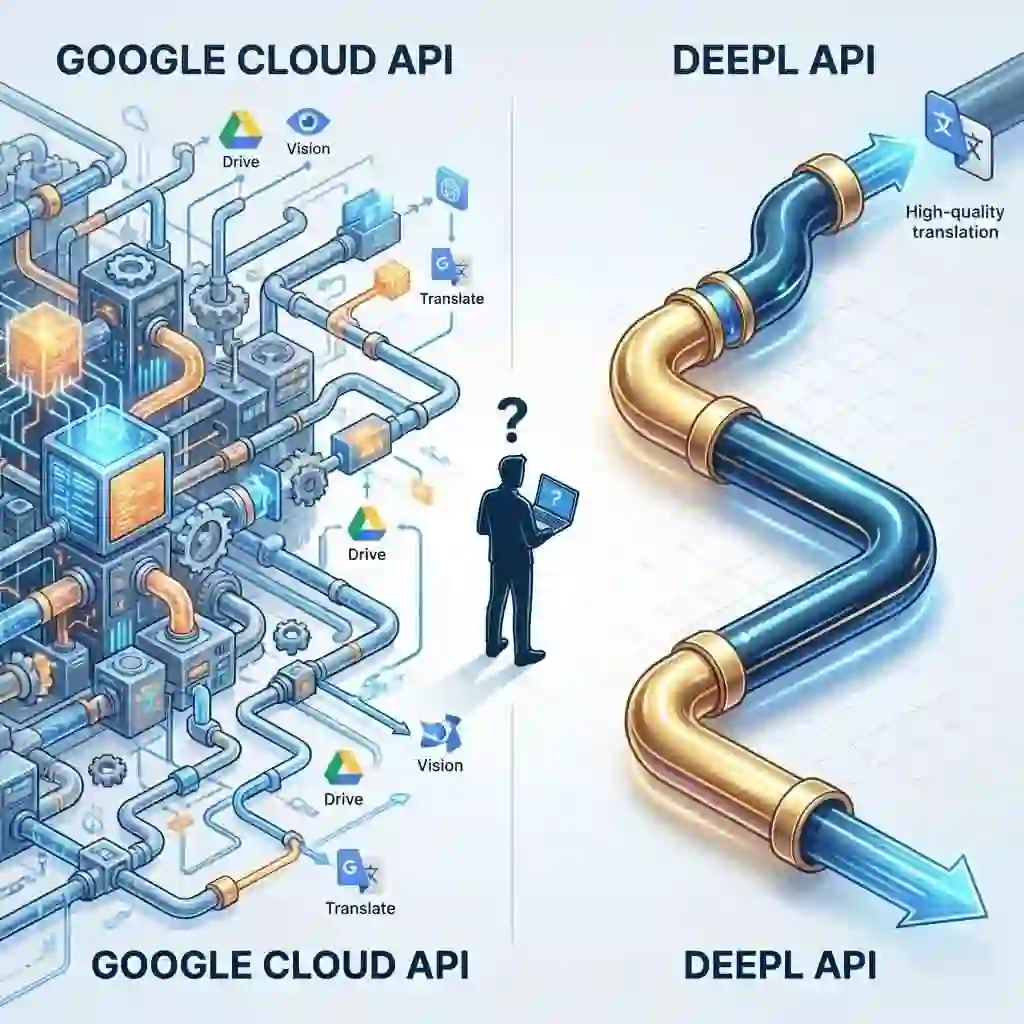
DeepL’s API supports fewer languages. Yet, users praise its simplicity and high quality. The choice in the DeepL vs Google Translate api debate varies. It depends on business needs. Do you need broad language support? Or do you need the highest possible accuracy in fewer languages? The DeepL vs Google Translate decision for developers is strategic.
| API Feature | DeepL API | Google Translate API |
|---|---|---|
| Pricing Model | Tiered subscription + per-character | Pay-as-you-go after free tier |
| Free Tier | 500,000 characters/month | 500,000 characters/month |
| Customization | Glossary support, formality control | Glossary, AutoML for custom models |
| Ease of Use | Generally simpler to implement | More complex, part of GCP |
| Key Advantage | Higher baseline translation quality | Massive language support & scalability |
3.2 Document Translation Capabilities: The Perfect Solution for Maintaining Formatting
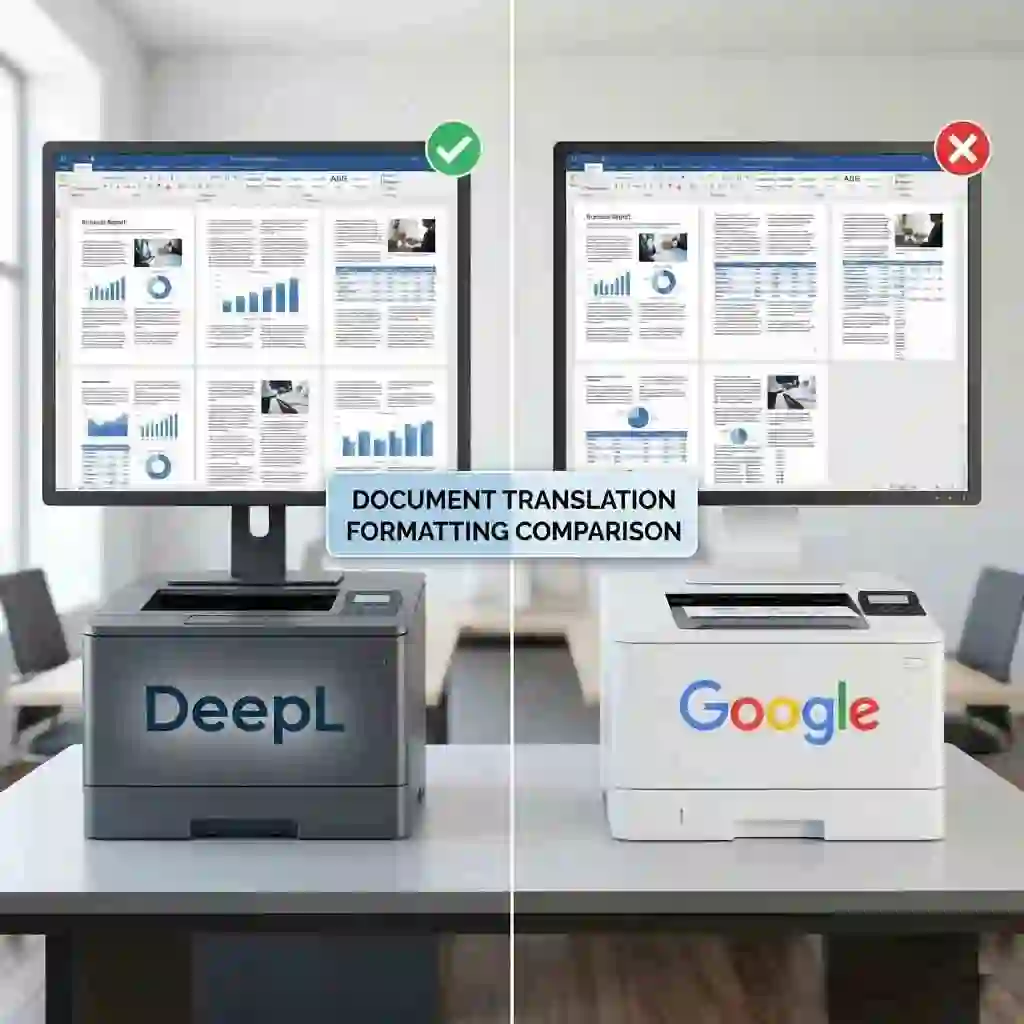
Both platforms function as powerful document translation software. They handle formats like .docx, .pptx, and .pdf. This is a huge time-saver. Users can translate entire files without losing the original layout. Performance as document translation software is a key factor. It is vital in the DeepL vs Google Translate comparison.
In our tests, both performed commendably. However, DeepL often had a slight edge. It preserved complex formatting, including tables. It also handled multi-column layouts better. This is a deciding factor for users with formatted documents. The DeepL vs Google Translate choice may come down to this detail.
This Reddit thread offers candid user feedback. It explains why they switched from Google to DeepL. It highlights practical advantages beyond standard reviews. These insights add to the DeepL vs Google Translate services discussion.
3.3 Exclusive Feature Comparison: Screen Capture Translation and Real-Time Conversation
Each service offers unique features. These cater to different needs. The DeepL screen capture tool is a standout. It allows users to translate text from anywhere on their screen. This is useful for translating text within images. It works for applications or non-selectable web content, too. It is a strong argument for DeepL when comparing DeepL vs Google Translate.
Google, in turn, excels with its real-time conversation mode. This is available in its mobile app. It facilitates spoken dialogue between two people. Its camera translation is also more integrated. It is feature-rich. These features make Google one of the best Google Translate alternatives for travelers. The DeepL vs Google Translate debate isn’t only about text.
3.4 Privacy and Security: Where Does Your Data Go?
Data privacy is a major concern. This is especially true for corporate users translating sensitive information. Here, the DeepL vs Google Translate policies differ. DeepL Pro states that it does not store subscriber text. It encrypts all data. This provides a clear assurance of confidentiality.
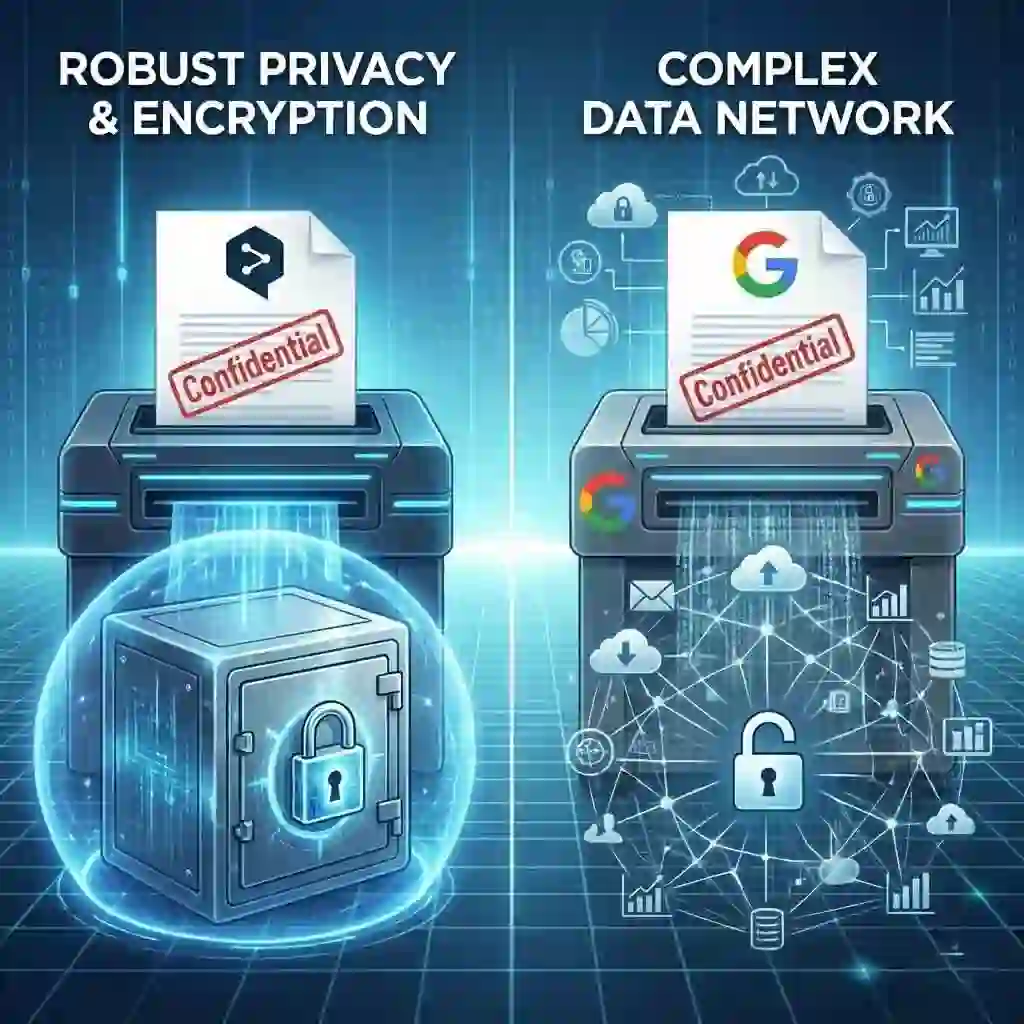
Google’s privacy policy is more complex. It is tied to its broader ecosystem. Google Cloud Translation for enterprise users offers strong security guarantees. However, the policy for the free service is less clear. DeepL offers a straightforward policy. For businesses prioritizing data security, this is an advantage. It matters in the DeepL vs Google Translate analysis.
4.The Ultimate Guide for Video Creators: DeepL vs Google Translate in Subtitle Translation
For video creators, subtitle translation is a gateway to a global audience. However, it presents unique challenges. Standard text translation does not face these. In this specialized DeepL vs Google Translate showdown, details matter. This makes the DeepL vs Google Translate choice critical for creators.
4.1 The Special Challenges of Subtitle Translation: Colloquialisms and Character Limits
Subtitle translation is an art. It requires capturing the essence of spoken dialogue. This dialogue is often informal. It is full of colloquialisms. Furthermore, translators must work within strict character limits. This ensures readability. This is where you might ask a question. Is there a translator better than Google Translate for this specific task?
In this context, a tool is invaluable. It must produce the most natural sounding translation. The DeepL vs Google Translate choice can impact viewer experience. A clunky, literal translation can ruin a scene. A fluid one enhances it.

4.2 SRT File Handling in Action: DeepL vs Google Translate
Most subtitles use .srt files. These files contain text and timestamps. A good document translation software for this purpose is essential. It must translate the text without corrupting the file’s structure. We tested both services with a sample .srt file. We wanted to see how they performed in this DeepL vs Google Translate test.
DeepL translated the content well. It preserved the timestamps and formatting. Google Translate also handled the file. However, it introduced minor formatting issues. These required manual correction. Creators often work with dozens of files. DeepL’s reliability as a document translation software for subtitles is a clear win. It takes the lead in the DeepL vs Google Translate race.
This 2026 video breakdown compares the two platforms. It offers up-to-date insights. This helps anyone making a decision in the current DeepL vs Google Translate landscape.
A 2026 video comparison
YouTube Video
4.3 Anime and Film Translation: Handling Cultural Gags and Catchphrases
Translating entertainment content is notoriously difficult. Anime is a prime example. It is filled with cultural references, puns, and unique catchphrases. A successful Japanese to English DeepL translation requires more than linguistic accuracy. It needs cultural fluency. The same is true for an English to Spanish DeepL translation of a Hollywood blockbuster.
We analyzed this in our DeepL vs Google Translate comparison. DeepL showed a distinct ability. It generated the most natural sounding translation. This helped it capture the spirit of the original dialogue.
It was more likely to find a culturally appropriate equivalent for a joke. It avoided translating it literally. This is a major point in the DeepL vs Google Translate matchup.
4.4 Why Professional Subtitle Tools Are Still Essential
The DeepL vs Google Translate battle shows impressive capabilities. However, neither is a perfect solution for professional subtitling. This is where a dedicated tool comes in. Solutions like subtitletranslator.org fill the gap.
It is not just about finding a translator better than Google Translate. It is about having a workflow built for the job.
Specialized tools offer features that generic translators lack. These include batch processing of multiple files. They also offer direct timeline editing and team collaboration.
They integrate the power of engines like DeepL. However, they place it within a professional workflow. This is designed specifically for video creators. This elevates the DeepL vs Google Translate discussion to a new level.
5.Language Support and Pricing Strategy: The Breadth vs. Depth Debate in DeepL vs Google Translate
Your choice in the DeepL vs Google Translate dilemma is simple. It may come down to two practical factors. Does it support your language? What does it cost?
Here, the two services present a classic case. It is breadth versus depth. This is a fundamental part of the DeepL vs Google Translate analysis.
5.1 Language Coverage: More and Comprehensive or Less and Refined?
Google Translate’s language library is vast. It supports over a hundred languages. This includes many less common and regional dialects.
You might need to translate from a language that isn’t widely spoken. In that case, Google is often your only option. This breadth is a major selling point in the DeepL vs Google Translate comparison.
DeepL takes a different approach. It focuses on a smaller list of around 30 languages. However, it offers unparalleled quality for these languages.
Take a German to English DeepL translation, for instance. The quality is consistently higher than Google’s. The question is DeepL accurate is best answered here. It applies best within its supported language pairs.
| Aspect | DeepL | Google Translate |
|---|---|---|
| Number of Languages | ~30+ | 130+ |
| Strategy | Quality over quantity | Maximum coverage |
| Best For | High-quality European languages | Niche and less-common languages |
| Example Strength | german to english DeepL | Translating regional dialects |
5.2 Free vs. Paid: Is Your Money Well Spent?
Both services offer excellent free versions. However, their limitations and paid tiers differ. The free version of DeepL has stricter character limits. The paid plans, DeepL Pro, offer enhanced security. They also provide unlimited text translation and API access. This is a key part of the DeepL vs Google Translate financial equation.
Google’s paid offering works differently. It is primarily available through its Cloud Translation API. This operates on a pay-as-you-go model after a generous free tier. This can be more cost-effective for users with fluctuating needs.
Deciding whether to pay is a specific choice. It often comes back to one question. Does the superior accuracy of DeepL justify the subscription cost? The DeepL vs Google Translate api pricing is a major factor for businesses.
This short video highlights the results of blind tests. It provides a quick, data-backed point. This is useful for social media audiences following the DeepL vs Google Translate quality debate.
DeepL blind test results reel
Instagram Video
5.3 Emerging Challengers: The Rise of Tools like DeepSeek Translation
No DeepL vs Google Translate discussion in 2026 is complete without looking at the landscape. It is evolving rapidly. New neural machine translation systems like DeepSeek translation are entering the market. They offer competitive performance. These platforms are becoming some of the best Google Translate alternatives.
DeepL and Google remain the top two contenders. However, it is worth keeping an eye on these challengers. They often innovate in specific niches. They may offer more competitive pricing. This adds new dimensions to the translation accuracy comparison. It pushes the entire industry forward. The DeepL vs Google Translate duopoly is being challenged.
6.How to Make Your Final Choice in DeepL vs Google Translate in 2026?
The great DeepL vs Google Translate debate doesn’t have a single winner. The best tool is the one that aligns with your specific needs, budget, and priorities. After this extensive comparison of translation accuracy, the choice should be clearer. This final analysis of DeepL vs Google Translate will guide your decision.
6.1 A Scenario-Based Decision Guide
To simplify your choice in the DeepL vs Google Translate contest, consider which of these profiles best describes you. This guide provides a clear verdict for the DeepL vs Google Translate dilemma based on common use cases.
| Your Profile | Recommended Tool | Why? |
|---|---|---|
| Quality-Focused Professional | DeepL | Offers the most natural sounding translation and higher accuracy for professional documents. |
| Casual User / Traveler | Google Translate | Unmatched language support and excellent real-time features like conversation and camera mode. |
| Developer / Business | It Depends | Evaluate the DeepL vs Google Translate api. Choose Google for scale, DeepL for quality. |
| Video / Subtitle Creator | DeepL (then a Pro Tool) | DeepL is the better raw engine, a translator better than Google Translate for subtitles. |
Ultimately, consider your needs. Are you a professional or a language learner? Do you value nuance and accuracy above all? If so, DeepL is likely your best bet.
Perhaps you need a versatile tool. You might need a jack-of-all-trades that handles any language you throw at it. In that case, Google Translate remains an unbeatable free resource. The DeepL vs Google Translate choice is yours.
6.2 Time to Action
As we’ve seen, the DeepL vs Google Translate showdown reveals a lot. Both tools are powerful. Yet, they have different strengths. Your primary use case should inform your choice. For general-purpose translation, both are excellent. The DeepL vs Google Translate competition has pushed both to be better.
But what if you are a content creator focused on video? You might require the most efficient subtitle translation experience. You need accuracy and a streamlined process. A generic tool won’t cut it. You need a solution built for your workflow.
Are you serious about taking your content global? Try subtitletranslator.org for free today. Experience the power of AI translation designed for creators!